The idea is still a deck
Nobody has watched a user try the workflow. We prototype the risky part before a full build.

Product engineering
We start from a product we already run when it fits, or from the codebase you have. We build only the next slice that proves the product, then host it and keep releasing.
Pick a stage. Now, next and later are what we would put in the first plan.
The first conversation is about which of these is true. We do not start with a rewrite.
Nobody has watched a user try the workflow. We prototype the risky part before a full build.
Demand is real. Accounts, tests and a release path are not. Paying customers would expose that.
Each feature touches too much of the core. Integrations fail in ways nobody can see until a customer does.
New work means freezing the roadmap or rewriting everything. We move one module at a time.
Retail, commerce, jobs, therapy or leadership reporting may not need a blank product. We say so before we build.
The team that shipped it is gone. Monitoring, releases and hosting need a named plan.
Each stage has a first slice. Choosing one fills the brief below if you have not written it yet.
Learn before a big build. The first slice is the smallest release that proves demand.
Demand is proved. The codebase and the operating model are not ready for paying customers.
Releases take longer. Integrations are fragile. We start with the biggest drag.
The architecture was not meant to last. We evolve it while you keep shipping.
Three parts. A blank rebuild is the last option, not the first.
1 · Base
Your existing product, or one we operate: ERP, SnapOS, CommerceNest, Buildora, Theraos, ExecLayer. If it covers the domain, we extend it.
2 · The slice
One workflow, the tests around it, and a staging release. Billing, extra modules and a rewrite wait until that slice holds.
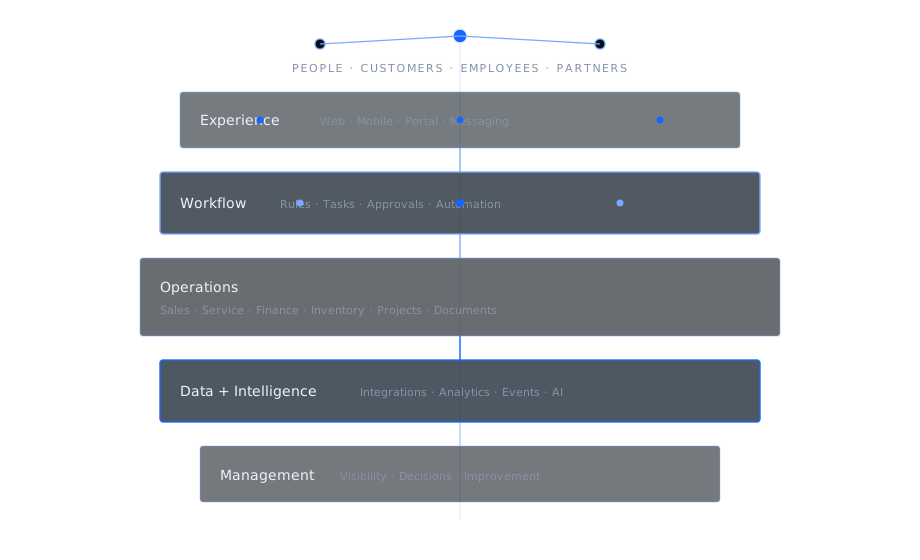
3 · After launch
CI, staging, monitoring and a care plan. Design of the next module is quoted separately. You own the code, as the contract says.
Each route can work. These are the differences that decide whether a product ships and lasts.
Each step leaves something you can open, not a status slide.
We build client products, and we run these ourselves. A custom product is for the part they do not cover. Measured client results are shared only with permission.
White-label, a team inside yours, or a referral. Your client relationship, brand and product ownership stay yours. Scope is written before work starts.
We engineer the product under your brand.
Our engineers inside your tools and review process.
Introduce a client. Terms are agreed in writing first.
The contract still sets the exact terms.
It depends on scope. We start with discovery, then propose a phased plan so you can see cost against value before committing. We do not publish a single price, because every product is different.
You do, as agreed in writing before work starts, along with how the product is deployed and handed over.
We choose proven, mostly open-source technology that fits the product and your team, and we explain the trade-offs so you are never locked in.
We scope the smallest release that proves your idea and put it in front of users early. The timeline is set after discovery, not promised before we have seen the product.
Yes. We can extend your engineering team when you need capacity, without you losing ownership of the product.
Yes. We stay on under a clear plan for releases, monitoring and improvements.
Start a conversation
We reply with whether a product we already run fits, what the next slice is, and how we would host it.
We will reply by email. If you do not hear from us, use the contact page.